The Fishin Frenzy demo looks identical until you try to cash out
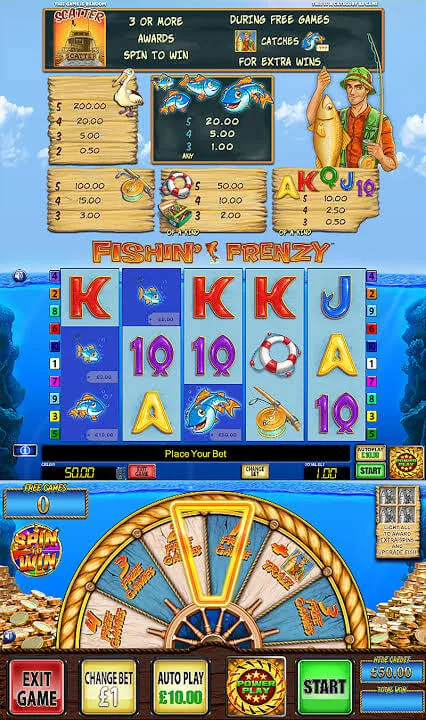
You click the demo button, the reels spin, a fisherman wild lands during free spins and reels in three fish for £24.50 in virtual credits. The win animation plays, the balance ticks up, and for a moment it feels like the real thing.
Then you remember: there's no withdrawal button, no KYC queue, no affordability check waiting at £150 in deposits. The Fishin Frenzy demo runs the same RTP and volatility as the licensed version, but the UKGC framework that governs real-money play in the United Kingdom — the £5 stake cap, the Faster Payments delay, the GAMSTOP register — doesn't touch it. This page unpacks what the demo gives you, what it hides, and the lowest-risk route from virtual credits to your first real spin.
Where the demo lives and whether you need an account
Most UKGC-licensed casinos host a Fishin Frenzy demo directly in their lobby. Since May 2019, Commission rules require age verification before you can load any free-to-play gambling game, so the majority of operators gate the demo behind registration. You'll hand over your name, date of birth, and postcode; the site checks you're 18-plus using a credit-reference bureau, then unlocks the demo with a balance of virtual credits — usually £100.00 to £1,000.00 that resets when you refresh.
A handful of aggregator portals and game-provider showcases let you spin without sign-up, but these sit outside the UKGC perimeter and won't lead you to a licensed cashier when you're ready to deposit. If you want a demo session that connects directly to a legal withdrawal path, register with a site whose UKGC licence number sits in the footer and whose name appears in the Commission's public register.
Blueprint Gaming (the distributor) and Reel Time Gaming (the developer) built one version of the slot; the demo runs the same client-side code, the same RNG seed system, and the same paytable as real money. The only operational difference is that your balance never touches the casino's payment processor.
What a demo session feels like: pace, range, and the free-spins trigger
The demo defaults to a £1.00 stake per spin — ten pence per payline across the ten fixed lines. You can usually adjust the bet from £0.10 up to the highest option the client offers, which in real play would be £5.00 under the UKGC stake cap for players 25 and over, or £2.00 if you're 18 to 24. The demo doesn't enforce these age-banded limits because it never asks for your exact birthdate beyond the initial 18-plus check, so you'll see the full range even if you're 22.
Each spin resolves in about two seconds if you tap through the animations, faster if you hold the space bar to turbo-spin. Land three boat scatters and you trigger ten free games; during that round the fisherman wild appears on the reels and collects every fish symbol's cash value in one sweep. The maths here — 96.12% RTP, medium volatility — match the licensed version exactly, so a lucky demo run where you hit four fishermen in the bonus isn't a tease; that sequence has the same probability in real money.
- Base-game pace: roughly 30 spins a minute if you're tapping steadily, ten to twelve minutes to burn through £100.00 in virtual credits at £1.00 per spin with typical hit frequency.
- Free-spins frequency: you'll trigger the boat scatter bonus once every 100 to 150 spins on average, though medium volatility means dry spells of 200-plus aren't unusual.
- Biggest demo win you're likely to see: a single bonus with multiple fishermen can return 50× to 150× your stake; the 5,000× max requires an almost-full screen of high-value fish and several wild collections.
Because the demo balance resets on refresh, you can test the same stake and spin count as many times as you like. That repeatability is the demo's clearest advantage: you learn the bonus cadence and the typical return per free-spins round without the affordability checks that kick in at £150 net deposits a month in real play.
Which numbers carry over and which evaporate at the cashier
The RTP, volatility, hit frequency, and maximum win are identical in demo and real money — these are properties of the game's maths model, not the funding method. If the demo's paytable says a full line of the top fish symbol pays 500 coins, the licensed version pays 500 coins. If you trigger free spins twice in 80 demo spins, that frequency is drawn from the same probability distribution that governs your real-money session.
What doesn't carry over: your virtual balance, your spin history, and any sense of loss aversion. In the demo you can chase a bonus for 200 spins, blow the pretend bankroll, refresh the page, and start again with no emotional or financial consequence. In real play that same 200-spin streak costs you between £20.00 and £1,000.00 depending on your stake, and there's no reset button — only a deposit limit you set during registration, a possible affordability review if you've moved £150 or more in a month, and the knowledge that Faster Payments takes the money from your bank account in seconds.
What the demo hides: KYC, wagering, and the first withdrawal
The moment you click «Deposit» on a UKGC-licensed site, you leave the demo's frictionless loop and enter the regulated pathway. The operator checks your identity and address against credit-reference data, then asks you to upload a photo of your driving licence or passport if the automated check flags a mismatch. This is standard KYC (know your customer) procedure under Commission licence conditions, and it happens before your first withdrawal — sometimes before your first deposit if the initial automated verification fails.
If you accept a welcome bonus, you'll meet wagering requirements: stake the bonus amount or the deposit-plus-bonus sum a certain number of times before you can withdraw. A £10.00 bonus with 35× wagering means £350.00 in total stakes, which at £1.00 per spin on Fishin Frenzy is 350 spins. The demo never mentions wagering because there's no bonus and nothing to withdraw; the first time you see the term is in the promotion's fine print.
Withdrawal speed depends on your payment method. E-wallets like PayPal clear in a few hours to 24 hours once your account is fully verified. Faster Payments to your bank account usually arrives the same day or within two working days. Your debit card — Visa and Mastercard are the standard options since credit cards were banned for gambling in 2020 — can take one to three working days. Your first withdrawal will always be the slowest because the compliance team reviews your documents, confirms the payment method is in your own name, and closes any outstanding KYC queries. After that, repeat withdrawals to the same card or bank account are usually faster.
Demo play on a phone: browser or app, and what changes on a small screen
The Fishin Frenzy demo runs in Safari, Chrome, and Samsung Internet without an install — you load the casino's site, tap the game tile, and the HTML5 client fills your screen. Blueprint Gaming built the slot as a responsive web app, so the reel grid scales down, the bet controls move to a hamburger menu, and the paytable opens as an overlay. You lose no features; the maths, RTP, and spin logic are identical to the desktop version.
A few UKGC-licensed operators package their lobby into a native iOS or Android app, available through the App Store and Google Play. If you download one of these, the demo lives inside the app's game library, gated by the same age-verification step you'd meet on the website. The demo balance, reset behaviour, and session persistence are the same; the only difference is that you're launching the game client from an installed app rather than a browser tab.
On a smaller screen — anything below six inches — the fish symbols and coin values can feel cramped during the free-spins collection animation. You'll still see every fisherman wild land and every cash value add to your total, but the visual feedback is less pronounced than on a laptop. If you're testing the game to understand the bonus mechanic, a tablet or desktop gives you a clearer view of which reels the wild appears on and how many fish it collects in one sweep.
Real-money differences the demo won't prepare you for
The £5.00 stake cap applies to every spin on a UKGC-licensed site if you're 25 or older; if you're 18 to 24, the cap drops to £2.00. The demo might let you select a higher bet because it doesn't know your exact age, but the moment you switch to real play the client will clamp your maximum stake to the legal limit. This means the largest win you can legally chase on Fishin Frenzy in the United Kingdom is £25,000.00 (5,000× multiplied by £5.00), or £10,000.00 if you're under 25.
Affordability checks start at £150.00 in net deposits over a rolling month — net meaning deposits minus withdrawals. When you cross that threshold, the operator pulls a soft credit-reference report to assess gambling spend against your income and credit profile. If the data suggests you're spending more than you can afford, the site may ask for payslips, bank statements, or a call with the responsible-gambling team before you can deposit further. The demo never triggers this process because no money moves, so your first encounter with affordability scrutiny will feel abrupt if you're used to unlimited demo reloads.
Loss hurts differently when it's real. A 200-spin cold streak in the demo costs you nothing; you refresh and try again. The same streak at £1.00 per spin in real play costs £200.00, and there's no undo. Medium volatility means these streaks will happen — the maths guarantee it — but your emotional response and bankroll management become load-bearing in a way the demo can't simulate.
The lowest-risk route from demo to real money
Start by checking the operator's UKGC licence. Open the Gambling Commission's public register, search for the casino's trading name, and confirm the licence number in the footer matches the register entry. If the site isn't listed, or if the licence is suspended, walk away — you have no legal recourse if a dispute arises, and your deposits aren't protected.
- Register and complete age verification. The site will ask for your name, address, date of birth, and sometimes the last few digits of your bank account or a recent utility bill. This is the KYC step the demo skips; expect it to take a few minutes if the automated checks pass, or 24 to 48 hours if you need to upload documents.
- Set deposit and loss limits during onboarding. UKGC rules require operators to offer these controls at registration, and you should use them. A £50.00 monthly deposit limit and a £20.00 daily loss limit give you a controlled environment to test real-money volatility without the risk of a blown bankroll.
- Make a small first deposit using a debit card or PayPal — £10.00 is enough. Avoid welcome bonuses on your first session; the wagering requirement adds a layer of complexity that obscures whether you're actually enjoying the game or just grinding through a promotional obligation.
- Play Fishin Frenzy at the same stake you tested in the demo, ideally £0.10 or £0.20 per spin. Track your session in terms of spins, not time: if you budgeted £10.00 and you're betting £0.10, that's 100 spins. Note how many free-spins triggers you hit, what each bonus returned, and whether the experience matches your demo expectations.
- Withdraw your balance after the session, even if it's only £3.50. This forces the first-withdrawal KYC process while the amount is trivial, so you learn the timeline and document requirements before you have a larger sum waiting in limbo.
If the session felt nothing like the demo — if the bonus didn't trigger in 100 spins, or if the loss progression made you uncomfortable — stop and reassess before you deposit again. The maths are identical, but the emotional weight isn't, and that gap is where recreational play tips into problem gambling. The UKGC framework (GAMSTOP, affordability checks, stake caps) exists to catch you before that point, but it works best when you're already monitoring your own response.
Why the demo is still worth an hour of your time
The Fishin Frenzy demo gives you every mechanical detail: the free-spins trigger rate, the fisherman wild's collection behaviour, the variance between a weak bonus (one wild, two fish, £8.00 return) and a strong one (three wilds, a dozen fish, £180.00). You'll learn whether ten free spins feels like enough, whether the base game's hit frequency keeps you engaged between bonuses, and whether medium volatility suits your temperament — all before the affordability machinery and withdrawal queues enter the picture.
What you won't learn: how it feels to watch £50.00 disappear in fifteen minutes, or to trigger a £200.00 bonus win and then decide whether to withdraw or chase a second one. Those lessons cost money, and the demo can't teach them. But it can tell you whether the game's maths and pacing are worth the cost of finding out.
The best demo session ends with a decision: either this game isn't for you and you've lost nothing, or it is and you're moving to real money with your eyes open — aware of the stake caps, the KYC delay, the affordability threshold at £150.00, and the fact that every spin's outcome is as random as the demo's, but every loss is permanent. That clarity is the demo's entire value.
FAQ
Do I need to register to play the Fishin Frenzy demo on a UKGC-licensed site?
Yes, almost always. Since May 2019, Commission rules require age verification before you can access any free-to-play gambling game, including demos. You'll register with your name, postcode, and date of birth; the site checks you're 18-plus using credit-reference data, then unlocks the demo with virtual credits. A few offshore aggregator portals offer no-registration demos, but these aren't connected to a legal UK cashier and can't lead to a licensed real-money session.
Does the demo use the same RTP and volatility as real-money play?
Yes. The demo runs the same client-side code, the same RNG system, and the same 96.12% RTP and medium volatility as the licensed version. The only difference is funding: your demo balance is virtual and resets on refresh, so there's no payment processor, no KYC, and no withdrawal queue. The maths — hit frequency, bonus probability, maximum win — are identical.
Can I test stakes above £5.00 in the demo, and will they work in real money?
The demo might let you select stakes above £5.00 because it doesn't enforce the UKGC's age-banded caps, but the moment you switch to real play the client will clamp your bet to £5.00 if you're 25 or over, or £2.00 if you're 18 to 24. Any demo session at a higher stake is testing a configuration you can't legally use in the United Kingdom, so it's not a useful rehearsal.
What happens when I make my first real-money deposit after playing the demo?
You'll enter the UKGC's KYC and affordability framework. The operator checks your identity and address, sometimes asking for a photo of your driving licence or passport. You'll set deposit and loss limits during registration. If you cross £150.00 in net deposits over a month, the site pulls a soft credit check to assess affordability. Your first withdrawal — even if it's small — triggers a compliance review that can take 24 to 48 hours while the team verifies your documents and confirms your payment method is in your own name. After that first cycle, repeat deposits and withdrawals are faster.