What Actually Works When You're Playing Fishin Frenzy
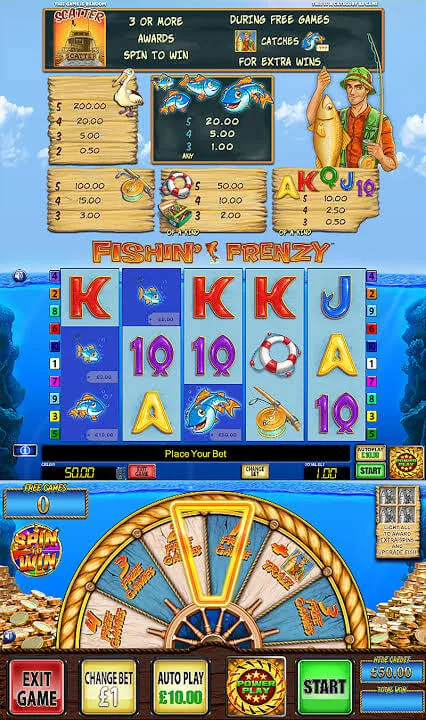
Three scatters land, the boat sails across the screen, and the free spins counter ticks up to ten. The fisherman appears on reel three, collects every fish symbol in view, and the total climbs — or it doesn't, because the reels came up empty. That single mechanic is the entire game, and it's why Fishin Frenzy has been the most-played slot on UKGC-licensed sites for years. Simple, volatile, and built around one moment that either pays or leaves you chasing the next trigger.
The trouble is that simplicity breeds myth. You'll hear about «hot streaks», patterns in the scatter drops, ways to time your stake changes, and other strategies that sound plausible until you remember the reels are governed by a random number generator audited by the UK Gambling Commission. What you can control isn't the outcome — it's the stake, the session length, the stop point, and the choice of whether to play at all. This is a guide to those levers, the costly mistakes that come from ignoring them, and the market rules that shape how much you can actually lose in a single session.
Why the Common «Strategies» Don't Work Against RNG
Every spin is independent. The game doesn't «remember» the last fifty spins, doesn't owe you a bonus round after a dry stretch, and can't be manipulated by changing your stake mid-session. The RNG produces a new result every time you press spin, drawn from millions of possible combinations, and the maths doesn't care whether you've been playing for two minutes or two hours.
Here's what doesn't work, and why:
- Raising your stake after a losing run to «force» a bonus — the next spin has the same probability as the first, and you're just burning through your balance faster.
- Dropping to minimum stake after a big win because the slot is «cooling off» — variance doesn't operate on a cooldown timer, and medium volatility means long gaps between features are normal.
- Tracking scatter patterns or reel positions to predict the next trigger — the symbols are weighted server-side, not arranged in a repeating sequence you can decode.
- Switching between manual and auto-spin to break a «curse» — the RNG doesn't distinguish between input methods, and superstition costs you more spins without changing the outcome.
The RTP of 96.12% is a long-term average calculated over millions of spins. In a single session of a hundred spins, your return could sit anywhere from zero to several hundred times your stake, and both extremes happen more often than the theoretical average. Medium volatility means you'll see regular small wins punctuated by stretches where nothing lands, and the free spins feature — the only route to serious multiples — triggers roughly once every hundred to two hundred spins depending on your luck. That's the reality, and no staking pattern changes it.
What You Can Actually Control (And How to Use It)
You can't touch the RNG, but you control four variables that determine how much damage a bad run does to your balance: stake size, session budget, stop conditions, and whether you play the base game or hunt free spins exclusively in the bonus-buy versions available on some UKGC sites.
Stake size matters because volatility amplifies it. A £5.00 spin — the maximum allowed under UKGC rules for players aged 25 and over, and £2.00 if you're 18–24 — gives you twenty spins from a £100 deposit, and a single dead stretch of fifteen spins without a win has already cost you £75.00. Drop to £0.50 and the same deposit gives you two hundred spins, enough headroom to ride out multiple dry runs and still have budget left when the feature finally triggers. The win ceiling scales with your stake, but so does the speed at which you hit zero.
Session budgets are the hard limit you set before you start: the amount you're prepared to lose in full, with no top-ups, no chasing, and no «just one more bonus». UKGC-licensed operators are required to offer deposit limits, and affordability checks now kick in from £150.00 net deposits a month, using credit-reference data to flag players spending beyond their means. That's a regulatory backstop, not a substitute for your own discipline. Decide the number before you log in, and walk when it's gone.
Stop conditions work both ways: a loss limit and a win target. If you're down 50% of your starting balance and the feature hasn't triggered, the maths hasn't suddenly turned in your favour — you're just deeper in a variance trough. If you've doubled your deposit and hit a strong free spins round, the next spin still carries the same house edge, and the common pattern is to give it all back. Set the exit point in advance, and stick to it even when it feels early.
How to Read Volatility (And What It Costs You in Practice)
Medium volatility sounds safe, but it means the game can go thirty or forty spins without a line win, then deliver three wins in five spins, then go quiet again for another stretch. The scatter symbols that trigger the feature don't land on a schedule, and the free spins round itself can pay anywhere from £0.00 — if the fisherman never appears or the reels don't show fish — to several hundred times your stake if the stars align. That spread is variance, and it's why two players with identical stakes and session lengths can walk away with completely different results.
Variance also determines how much bankroll you need to survive the gaps between features. If you're playing £1.00 spins and want a realistic chance of hitting at least one bonus round before you run dry, you need £100.00 to £150.00 in your balance — and even that's no guarantee, because the scatter trigger is probabilistic, not guaranteed after a fixed number of spins. Anything less and you're at serious risk of busting out before the feature lands, especially if the first fifty spins return only small line wins or nothing at all.
The maximum win is capped at £250,000 per game round under UKGC rules, which affects you only if you're staking close to the £5.00 limit and hit a massive multiplier during free spins. For most players on £0.50 to £1.00 stakes, the practical ceiling is how many fish symbols land with high values when the fisherman collects, and that varies wildly. A strong round might deliver 200x, a weak one might return 10x, and most fall somewhere in between. Volatility means you can't rely on any single feature to recover your session losses, and chasing that recovery is where the damage compounds.
The Expensive Mistakes (And How They Compound)
The worst financial decisions happen after a bad run, not during it. You're down £80.00 from a £100.00 deposit, the feature hasn't triggered, and the instinct is to top up another £50.00 and raise the stake to «win it back faster». The house edge doesn't change, the RNG doesn't compensate, and you've just turned an £80.00 loss into a potential £130.00 loss with higher stakes eating through the new deposit in minutes.
Chasing losses is expensive because it stacks variance on top of emotion. Every additional deposit extends the session beyond the point where you should have stopped, and the maths hasn't improved — you're just feeding more money into the same game with the same RTP and the same medium volatility that created the losing streak in the first place. UKGC-licensed operators are required to monitor this behaviour, and affordability checks from £150.00 a month exist specifically to catch players in this loop. If you've hit that threshold, the answer isn't to switch sites; it's to stop.
Another costly mistake: ignoring the wagering requirements on bonus funds. If you've claimed a welcome offer — common examples on the UK market include 50 free spins or a 100% match up to £100.00, though terms vary widely by operator — the winnings from those spins are locked behind a wagering requirement, typically 35x to 50x the bonus amount. That means £10.00 in bonus wins requires £350.00 to £500.00 in total stakes before you can withdraw, and every spin on Fishin Frenzy eats into that total at whatever stake you've chosen. The feature might trigger, but the wagering clock is still running, and if your balance hits zero before you've cleared the requirement, the bonus wins disappear.
The final mistake is playing without knowing the operator's withdrawal process. UKGC-licensed sites require identity verification before your first withdrawal — proof of age, address, and payment method ownership — and that check can take 24 to 48 hours. E-wallets are fastest for payouts, often clearing in a few hours, while Faster Payments to a UK bank account typically take same-day to two working days, and debit card withdrawals can stretch to three working days. If you've won and want the money out, expect the first withdrawal to be the slowest, and don't assume instant access. Credit cards have been banned for gambling in the UK since April, so every deposit and withdrawal must use a payment method in your own name: debit card, PayPal, Apple Pay, Open Banking, or paysafecard.
How to Structure a Session With a Fixed Limit
Start with the maximum you're prepared to lose, and reverse-engineer the stake from that number. If your session budget is £50.00 and you want at least a hundred spins — enough to give the feature a realistic chance of triggering — your stake is £0.50. If you're willing to risk higher volatility and fewer spins, you can raise the stake, but every increase reduces the number of chances you have to hit the bonus round before your balance runs out.
Set two exit points: a loss limit and a win target. The loss limit is the point at which you stop, no matter how close you feel to a trigger. A common structure is 50% to 70% of your starting balance — so if you began with £50.00, you walk at £15.00 to £25.00 remaining. The win target is the profit level that triggers a withdrawal: if you're up 50% or more, cash out part of it and either stop or continue with a reduced stake. The target keeps you from giving back the entire win, and the limit keeps you from chasing losses into a deeper hole.
Track your spins and features manually if the operator's session history isn't detailed enough. Most UKGC sites show your last few rounds, but if you want to know how many spins it took to trigger the feature, or how much you've wagered in the current session, you'll need to count. That visibility makes it harder to drift past your own limits, and it gives you data for future sessions: if the feature typically triggers every 150 spins in your experience, and you're at 200 spins without one, you're either in an unlucky outlier or you've misjudged the pattern, but either way the maths hasn't turned in your favour.
If you're using a welcome bonus, factor the wagering requirement into your session plan. A 35x requirement on a £10.00 bonus means £350.00 in total stakes, and at £0.50 per spin that's 700 spins. If your deposit is £50.00 and the bonus adds £10.00, you have £60.00 in playing balance, but you need to clear 700 spins' worth of wagering before any winnings become withdrawable. The feature might trigger multiple times in that window, or not at all, and if your balance hits zero before you've cleared the requirement, you lose the lot. Don't claim a bonus unless you're prepared to play through the wagering in full, and don't assume the bonus funds are «free money» — they're locked until you've met the terms.
FAQ
Does raising your stake after a losing streak improve your chances of triggering the bonus?
No. Every spin is independent, generated by an RNG that doesn't track your history or adjust probabilities based on previous results. Raising your stake just means you lose your remaining balance faster, with no change to the likelihood of the feature triggering on the next spin. The scatter symbols appear at the same weighted frequency regardless of your stake size.
How much bankroll do you need to have a realistic chance of hitting the free spins feature?
For £1.00 spins, you'd want £100.00 to £150.00 to cover the typical gap between feature triggers, which sits around 100 to 200 spins depending on variance. At £0.50 spins, £50.00 gives you a similar window. Less than that and you're at serious risk of running out before the feature lands, especially if the first stretch of spins returns only small wins or nothing.
Can you withdraw winnings immediately after a big free spins round?
Only after you've completed identity verification — UKGC rules require proof of age, address, and payment method before your first withdrawal, and that check typically takes 24 to 48 hours. If you're playing with bonus funds, you also need to clear the wagering requirement before any winnings become withdrawable. E-wallets are fastest after verification, often a few hours, while Faster Payments to a UK bank take same-day to two working days.
Is the RTP of 96.12% a guarantee you'll get that percentage back in your session?
No. The RTP is a long-term statistical average calculated over millions of spins. In a single session of a hundred or two hundred spins, your actual return could be anywhere from zero to several hundred times your stake, and both extremes are well within normal variance. Medium volatility means the results cluster around the average over time, but any individual session can land far outside it.
What happens if you hit the £250,000 maximum win cap during free spins?
Your payout is capped at £250,000 regardless of the multiplier the fisherman collected, and the round ends. This limit is set by UKGC regulations and applies per game round, not per session. For most players staking £0.50 to £1.00, the practical ceiling is determined by how many high-value fish land during the feature, which varies round to round — the regulatory cap only comes into play if you're betting close to the £5.00 maximum and hit an extreme multiplier.